top of page

Research

Public·1 member

Single-Dose Psilocybin Treatment for Major Depressive Disorder

Findings  In a randomized, placebo-controlled, 6-week trial in 104 adults, a 25-mg dose of psilocybin administered with psychological support was associated with a rapid and sustained antidepressant effect, measured as change in depressive symptom scores, compared with active placebo. No serious treatment-emergent adverse events occurred.


Meaning  A 25-mg dose of psilocybin was well tolerated and may hold promise as a treatment for major depressive disorder when combined with psychological support.


Abstract


Importance  Psilocybin shows promise as a treatment for major depressive disorder (MDD).


Objective  To evaluate the magnitude, timing, and durability of antidepressant effects and safety of a single dose of psilocybin in patients with MDD.


Design, Setting, and Participants  In this phase 2 trial conducted between December 2019 and June 2022 at 11 research sites in the US, participants were randomized in a 1:1 ratio to receive a single dose of psilocybin vs niacin placebo administered with psychological support.…

6 Views

Wholeness MDMA Research

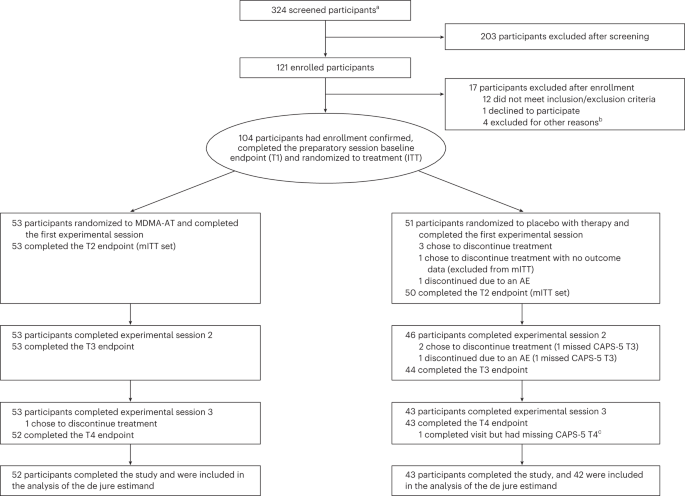
MDMA-assisted therapy (MDMA-AT) showed significant benefits in reducing the symptoms of post-traumatic stress disorder (PTSD) when compared to a placebo used alongside therapy. This was measured by looking at changes in the total severity score of PTSD symptoms from the start of the treatment to 18 weeks later.


The analysis used a statistical method called Mixed Models for Repeated Measures (MMRM). It found that the group receiving MDMA-AT had a bigger reduction in their PTSD symptom score compared to the group receiving a placebo with therapy. Specifically, the group with MDMA-AT had an average reduction of -23.7 points, while the placebo with therapy group had an average reduction of -14.8 points. This difference was quite significant, with a value of -8.9 points, and it was found to be highly statistically significant (P < 0.001).


To put it in perspective, the effect size of MDMA-AT compared to the placebo with therapy…


4 Views

Curcumin

Managing Metabolic Side Effects


Metabolic issues are quite common in individuals with schizophrenia, even before they start taking any medications. However, when they are treated with certain newer antipsychotic drugs, these metabolic problems can become more severe, particularly affecting their lipid (fat) levels in the blood and increasing the risk of heart-related problems.


Clozapine is considered a last-resort treatment for cases of schizophrenia that do not respond well to other medications. However, it has its own set of challenges. While factors like increased appetite, higher food intake, and a sedentary lifestyle can contribute to unhealthy lipid levels, clozapine may also affect how the body handles lipids through other mechanisms.


One of these mechanisms involves a molecule called adenosine monophosphate-activated protein kinase (AMPK), which plays a crucial role in regulating energy and lipid metabolism in the liver. Medications like clozapine, as well as some other antipsychotic drugs, can reduce the activity…


4 Views

Suicidal Ideation and qEEG Findings

Abstract

Suicide is a global phenomenon that impacts individuals, families, and communities from all income groups and all regions worldwide. While it can be prevented if personalized interventions are implemented, more objective and reliable diagnostic methods are needed to complement interview-based risk assessments. In this context, electroencephalography (EEG) might play a key role. We systematically reviewed EEG resting state studies of adults with suicide ideation (SI) or with a history of suicide attempts (SAs). After searching for relevant studies using the PubMed and Web of Science databases, we applied the PRISMA method to exclude duplicates and studies that did not match our inclusion criteria. The selection process yielded seven studies, which suggest that imbalances in frontal and left temporal brain regions might reflect abnormal activation and correlate with psychological distress. Furthermore, asymmetrical activation in frontal and posterior cortical regions was detected in high-risk depressed persons, although the pattern in the…


3 Views

Subscribe Form

Thanks for submitting!

  • Facebook
  • Twitter
  • YouTube
  • Pinterest
  • Instagram

©2022 by Wholeness Center

bottom of page