Wholeness MDMA Research
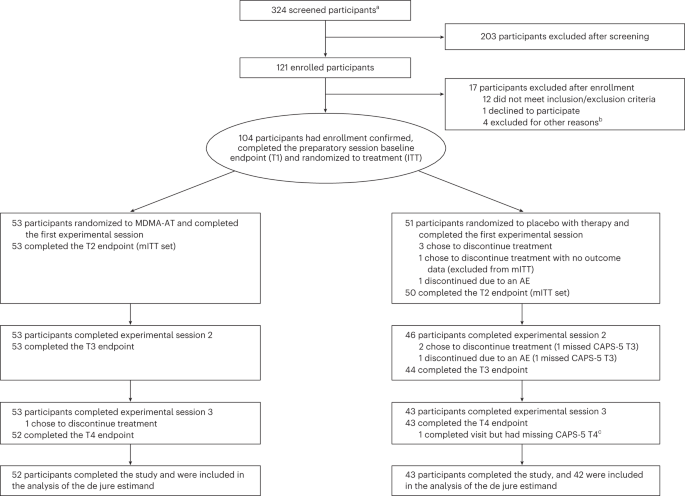
MDMA-assisted therapy (MDMA-AT) showed significant benefits in reducing the symptoms of post-traumatic stress disorder (PTSD) when compared to a placebo used alongside therapy. This was measured by looking at changes in the total severity score of PTSD symptoms from the start of the treatment to 18 weeks later.
The analysis used a statistical method called Mixed Models for Repeated Measures (MMRM). It found that the group receiving MDMA-AT had a bigger reduction in their PTSD symptom score compared to the group receiving a placebo with therapy. Specifically, the group with MDMA-AT had an average reduction of -23.7 points, while the placebo with therapy group had an average reduction of -14.8 points. This difference was quite significant, with a value of -8.9 points, and it was found to be highly statistically significant (P < 0.001).
To put it in perspective, the effect size of MDMA-AT compared to the placebo with therapy was 0.7, which indicates a substantial positive impact. Within each group, the effect sizes were 1.95 for MDMA-AT and 1.25 for placebo with therapy, further highlighting the effectiveness of MDMA-AT in reducing PTSD symptoms.
This research suggests that using MDMA as part of therapy appears to be very promising for helping people with PTSD, as it significantly reduced their symptoms when compared to using a placebo with therapy. People experienced better functioning in various aspects of their lives, including their family life, social life, and work life, compared to those in the placebo with therapy group. In simpler terms, the use of MDMA in therapy seems to have positive effects on a person's ability to manage their daily activities and responsibilities.